The Template Problem Nobody Talks About
I'll be honest - I've launched more microservices than I care to count. And early in my career, each one felt like reinventing the wheel. Where do the use cases go? How do I separate domain logic from infrastructure concerns? Should this validation live in the API controller or deeper in the stack?
The answer to these questions shouldn't change from service to service, yet I've seen teams (including my own) struggle with this consistency problem repeatedly. That's why I'm increasingly convinced that the structure you start with matters far more than the technology you choose.
Why Domain-Driven Design Layers Actually Matter
When I first encountered DDD layering, it felt like academic overhead. Three layers? Domain, Application, Infrastructure? Seemed like overkill for a "simple" microservice. Fast forward a few years and several production incidents later, and I've completely changed my tune.
Here's what I've learned: microservices don't stay simple. That elegant CRUD service you built last quarter? Give it six months and it'll be handling complex business rules, integrating with three external systems, and processing events from a message bus.
The BytLabs.MicroserviceTemplate approach of clearly separating these concerns isn't about being pedantic - it's about survival. Let me break down why each layer earns its keep:
Domain Layer: Your Business Truth
This is where your actual business logic lives - the rules that would exist even if you weren't building software. In healthcare systems I've worked on, this might be eligibility rules, clinical workflows, or compliance requirements.
Key insight: If you can't explain a piece of code to a domain expert without mentioning databases, APIs, or frameworks, it probably doesn't belong in the Domain layer.
Application Layer: The Orchestrator
This is your use case hub. Each use case represents something a user (or system) wants to accomplish. "Register a new patient." "Process a claim." "Generate an eligibility report."
What I love about making use cases explicit is the clarity it brings to your codebase. New developers can look at the Application layer and immediately understand what the service does without diving into implementation details.
public class ProcessClaimUseCase : IProcessClaimUseCase
{
    private readonly IClaimRepository _repository;
    private readonly IEligibilityService _eligibilityService;
    private readonly IEventPublisher _eventPublisher;

    public async Task<ClaimResult> ExecuteAsync(ProcessClaimRequest request)
    {
        // 1. Load domain entities
        var claim = await _repository.GetByIdAsync(request.ClaimId);

        // 2. Execute domain logic
        var result = claim.Process(request.ProcessingDate);

        // 3. Persist changes
        await _repository.UpdateAsync(claim);

        // 4. Publish events
        await _eventPublisher.PublishAsync(new ClaimProcessedEvent(claim));

        return result;
    }
}
Notice how the use case orchestrates but doesn't contain business rules? That's the sweet spot.
Infrastructure Layer: The Messy Real World
This is where you deal with databases, message queues, external APIs, and all the things that make production systems complicated. The goal is to keep this stuff from bleeding into your domain logic.
In practice, this means your Entity Framework configurations, your Azure Service Bus implementations, your HttpClient wrappers - they all live here, hidden behind interfaces defined in the Application or Domain layers.
The Template Advantage
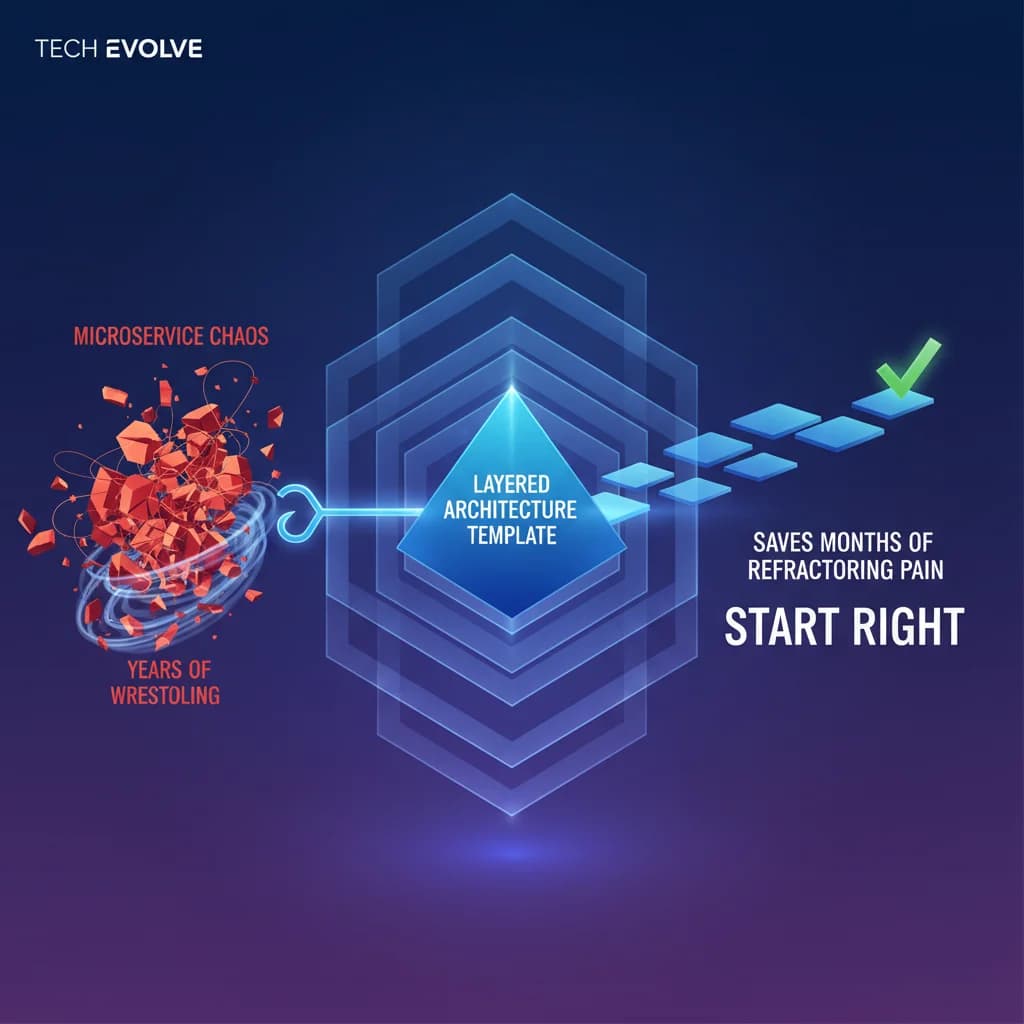
Here's where a template like BytLabs.MicroserviceTemplate shows its value: it makes these architectural decisions for you upfront. You're not debating layer boundaries during sprint planning. You're not refactoring your entire service when you realize your API controllers have become 500-line monstrosities.
The structure guides you toward better decisions:
- Testability: Domain logic without infrastructure dependencies? Easy to unit test.
- Flexibility: Need to swap databases? Only the Infrastructure layer changes.
- Onboarding: New team members know exactly where to find things.
- Consistency: All your microservices follow the same patterns.
My Hard-Earned Lessons
After implementing this layered approach across multiple teams:
-
Start strict, relax later: It's easier to merge layers if you truly don't need them than to split them after mixing concerns.
-
Use cases are documentation: Well-named use cases with clear interfaces are better than most technical documentation.
-
The Domain layer should be boring: No async/await, no database attributes, no JSON serialization. Just pure business logic.
-
Invest in the right abstractions: The interfaces between layers are your contracts. Get these right and everything else follows.
The Bottom Line
You don't need a template to build microservices. But you absolutely need consistent structure to maintain them. Whether you use BytLabs.MicroserviceTemplate or create your own, the key is having clear boundaries between domain logic, use cases, and infrastructure concerns.
Your future self - the one debugging a production issue at 2 AM - will thank you for making these decisions upfront rather than letting each service become a unique architectural snowflake.
Actionable takeaway: Before starting your next microservice, define your layering strategy. Draw the boundaries. Decide what goes where. Document it. Then use a template or starter kit that enforces those decisions. The hour you spend on structure now saves weeks of refactoring later.